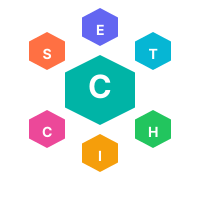
The ETHICS Digital Resiliency Framework
A holistic digital resiliency framework with six pillars addressing every dimension of cyber resilience. Created by Cybergiene, grounded in research, and built into every microapp.
Why a new framework?
Existing approaches to digital safety are fragmented. Awareness training exists in isolation, security tools don't educate, and none of them adapt to the individual. ETHICS unifies all six dimensions into a single, coherent model where each pillar reinforces the others.
Most importantly, ETHICS wraps everything in Resilience, the structural layer ensuring individuals and communities can absorb, recover, and continue in the face of cyber threats. It's about endurance as much as prevention.
Education
Awareness is the foundation. Without understanding threats, people can't protect themselves. We make learning continuous, engaging, and tailored rather than a one-off compliance checkbox.
Tools
Knowledge without tools is frustration. We give people practical, easy-to-use security solutions like QR scanners, password managers, and network monitors that work instantly.
Hygiene
Security is a habit, not a product. Like brushing your teeth, digital hygiene must become second nature. We track, nudge, and gamify daily security habits until they stick.
Intelligence
You can't defend against what you don't know exists. We surface real-time threat intelligence tailored to your profile, your location, and your digital footprint.
Community
Security is a team sport. From family safety plans to peer mentoring, we build shared responsibility because one person's weakness becomes everyone's vulnerability.
Safety
Protection, response, and recovery. From fraud detection to incident response to keeping families safe online, Safety is the pillar that catches you when prevention fails.
ETHICS, delivered
Every MicroApp in the Cybergiene ecosystem maps to an ETHICS pillar. These three showcase how the framework becomes a product.
YourDigitalThreat
Intelligence pillarYour personal threat graph, in real-time
YourDigitalThreat ties together your profile, your digital assets, active threats, and real-world context using a graph database. It connects your accounts, devices, and location to breach data, scam campaigns, and vulnerabilities so you see how threats actually relate to you, not a flat list of generic alerts.
How it works
- Ingests your profile, accounts, devices, and digital footprint into a threat graph
- Links your assets to breach databases (15.3B+ compromised accounts), active campaigns, and CVEs
- Graph relationships surface why a threat matters to you: this breach exposed this password on this account
- Tracks your risk posture over time as you close gaps across ETHICS pillars
Key figures
Breached accounts indexed
HIBP
Target response time
ETHICS Framework
Identity records recaptured in 2024
SpyCloud 2025
SecQRty
Tools pillarSee where a QR code leads before you go there
Quishing (malicious QR codes) is one of the 12 ACSC threat categories. SecQRty scans any QR code and previews the destination URL before you visit it. No more blindly trusting a QR code stuck to a parking meter or restaurant table.
How it works
- Scan any QR code with your camera
- See the full destination URL before visiting
- Automatic threat check against known malicious domains
- One tap to proceed or block; you're always in control
Key figures
ACSC threat #7 of 12
ACSC 2026
Safety News
Intelligence pillarThreat news tailored to your world
Generic cybersecurity news is noise. Safety News filters the threat landscape through your profile (your age, location, whether you're a parent or carer, what industry you work in) and surfaces only what matters to you. All processed on-device, free from privacy concerns.
How it works
- Curated from authoritative sources (ACSC, OAIC, industry feeds)
- Filtered by your profile: location, age, parental status, interests
- On-device processing so your profile never leaves your phone
- Adaptive learning: the more you engage, the better it understands your needs
Key figures
Cybercrime reports in FY2024-25
ASD 2025
Victims who actually report
AIC 2024
A decade of escalation
Threats evolve faster than awareness. Each year brings a new attack paradigm while most people's security knowledge remains stuck in the password era.
Rise of Ransomware
CryptoLocker and its variants made ransomware a household term
Nation-State Attacks
WannaCry and NotPetya caused billions in damage worldwide
Supply Chain Compromise
Attackers shifted to targeting trusted software providers
Remote Work Attack Surface
COVID-19 forced rapid digital transformation, exposing millions
Critical Infrastructure
Colonial Pipeline showed physical infrastructure was vulnerable
AI-Powered Attacks
Deepfakes and AI-generated phishing reached mainstream
LLM Weaponisation
WormGPT and FraudGPT lowered the barrier for cybercrime
Identity-First Attacks
MFA fatigue, SIM swapping, and session hijacking dominate
Quantum Threat Horizon
NOW"Harvest now, decrypt later": data stolen today becomes vulnerable tomorrow
Threats accelerate. Awareness doesn't.
ETHICS is designed for this reality: a framework that evolves with the threat landscape, not one that's frozen in a slide deck from 2019.
Grounded in research
ETHICS: A Holistic Framework for Consumer Digital Safety
Kenny Zhong, Cybergiene Pty Ltd, 2026
This paper introduces the ETHICS Digital Resiliency Framework, a six-pillar model (Education, Tools, Hygiene, Intelligence, Community, Safety) wrapped in a Resilience layer. Unlike traditional cybersecurity frameworks that address technical controls in isolation, ETHICS unifies awareness, practical tools, daily habits, threat intelligence, community support, and active protection into a single, adaptive ecosystem where each pillar reinforces the others.
Coming Soon